A mandate, step by step.
A Solon mandate is a properly run financing process, owned end to end by a senior adviser, run across the whole market and built around the best available terms.
Frame the credit story.
Every mandate begins with structuring advice and credit positioning. We set out the business, the funding requirement and the credit case the way a credit committee reads it.
Getting the story right at the outset is what shapes the terms later, because a credit that is well framed and well prepared is one a lender competes for.
- Solon produces
- A funding strategy: the amount, the structure and the credit angle to lead with.
- The client provides
- Three years of accounts and current management figures, and time with the people who run the business.
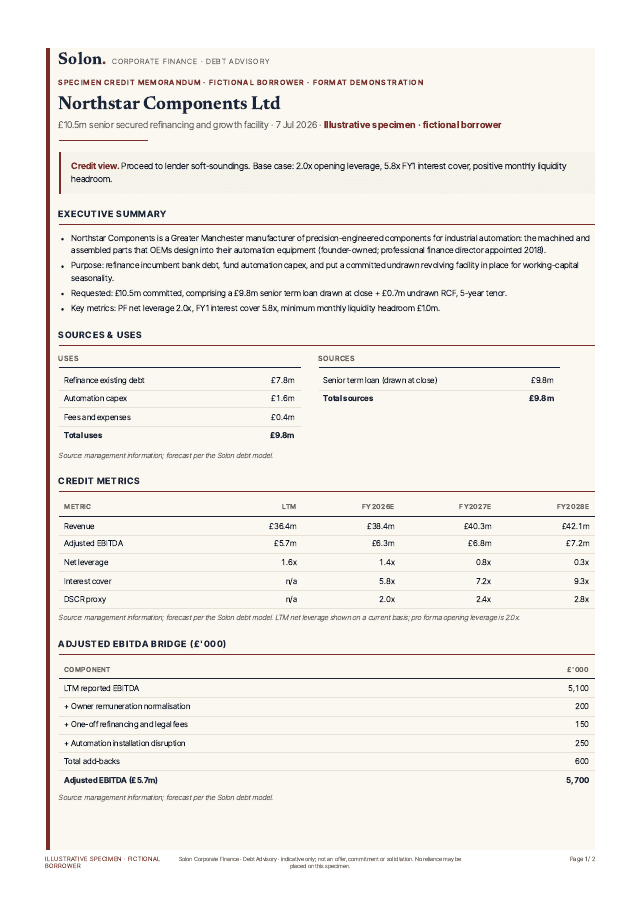
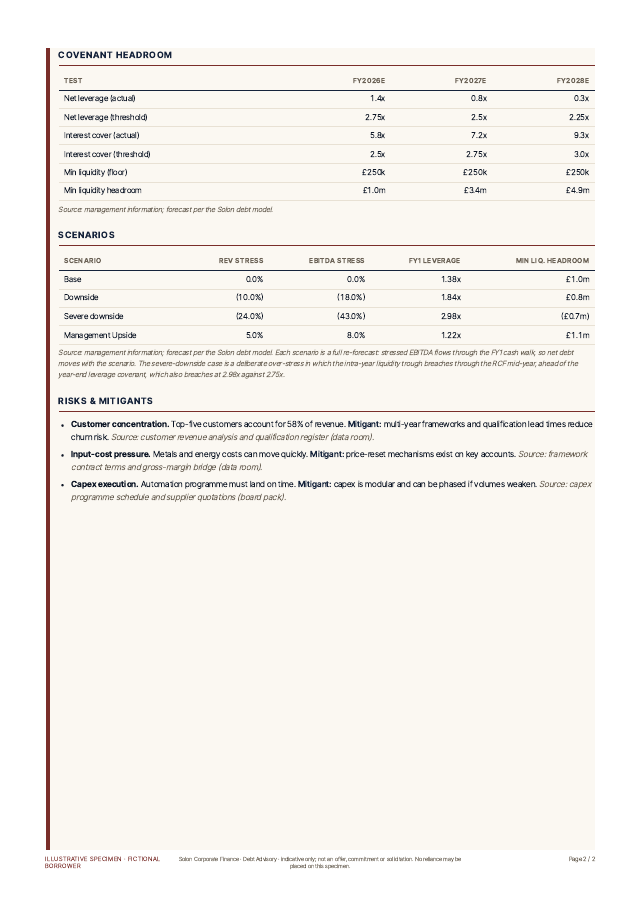
The credit memorandum
Prepare the materials.
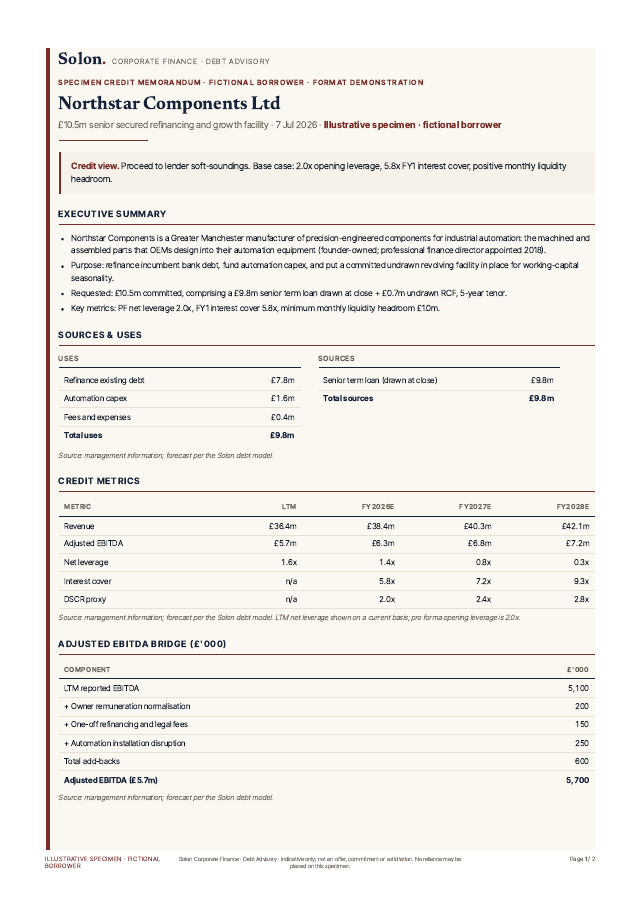
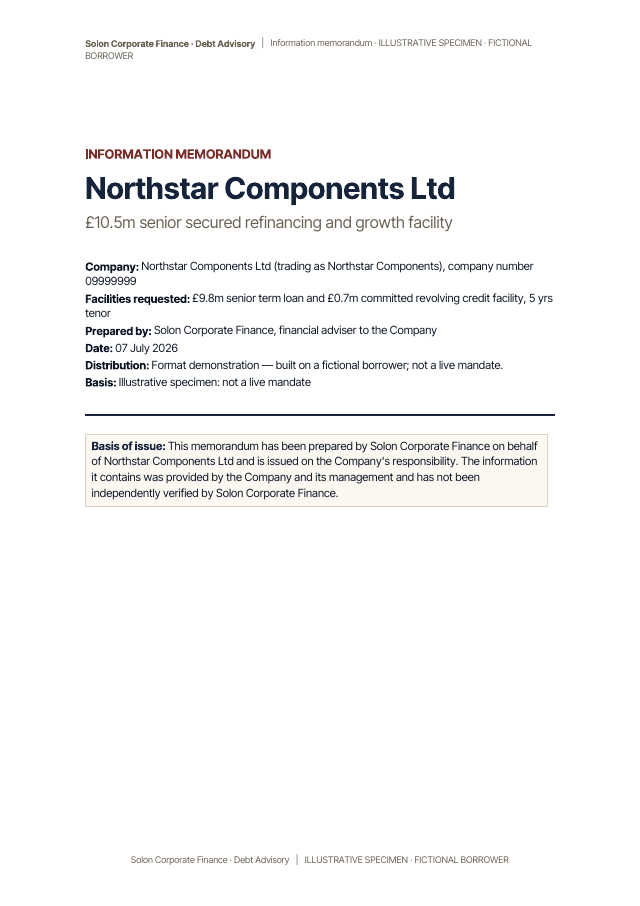
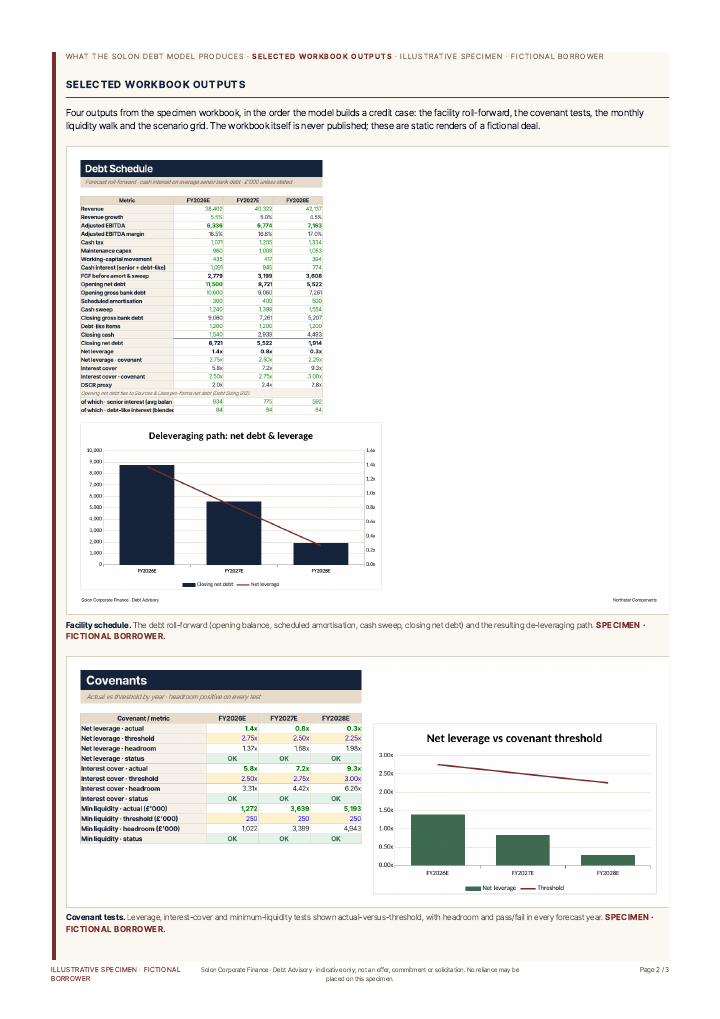
We write the information memorandum, build the financial model, prepare the management presentations and assemble a complete data room, to institutional standard. A lender has everything it needs to form a credit view, with nothing left to chase.
This is the work that keeps a financing moving, because the case is made before the market sees it.
For the finished article, see what the work product looks like →.
- Solon produces
- The information memorandum, financial model, management presentation and a complete data room.
- The client provides
- A forecast and the underlying detail, and sign-off on the numbers and the story before they go out.
Most of a raise runs twelve to sixteen weeks from mandate to money, depending on complexity and how ready the information is. Steps 01 and 02 are the first few weeks; the market work and the negotiation are where the value is made.
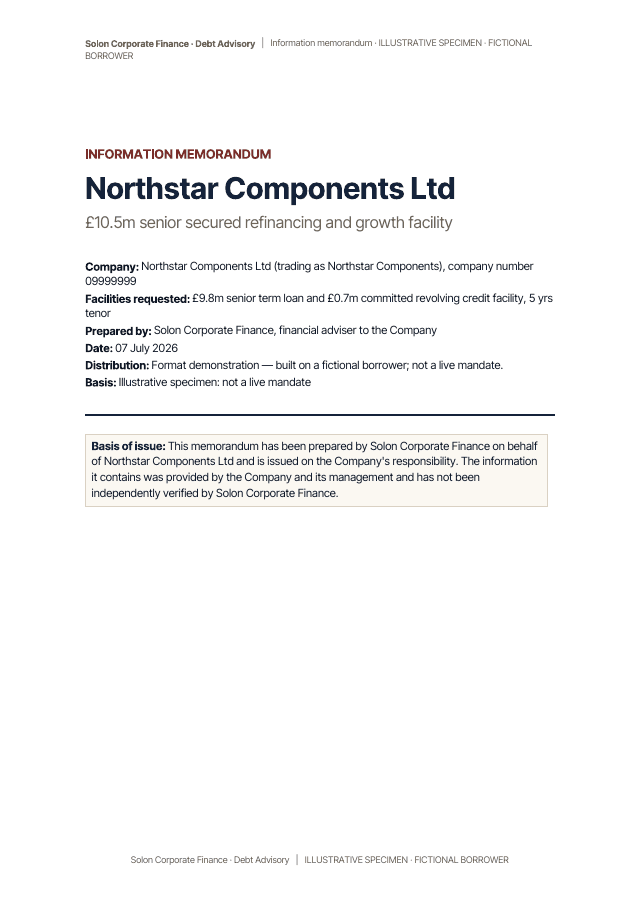
The materials
Identify and approach the relevant lenders.
We identify the right counterparties across the full spectrum of capital providers, from banks to specialist lenders to private-credit funds, drawn from a live read of appetite built from the other side of the table, not a fixed list. Then we run a competitive process.
Reading appetite from the other side of the table is how we know which lenders fit the deal rather than only the obvious ones.
- Solon produces
- A ranked shortlist of lenders, the approach, and indicative terms brought back in parallel.
- The client provides
- Management time for lender meetings, and prompt answers to the questions a live process throws up.
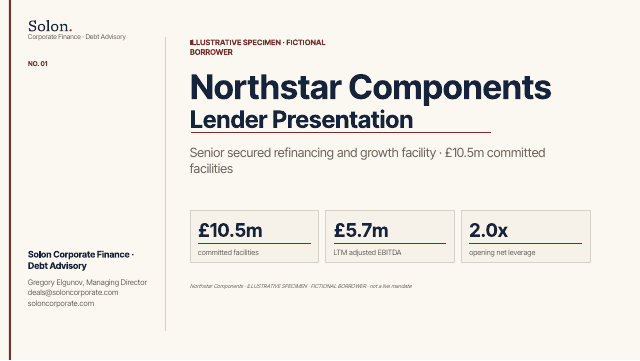
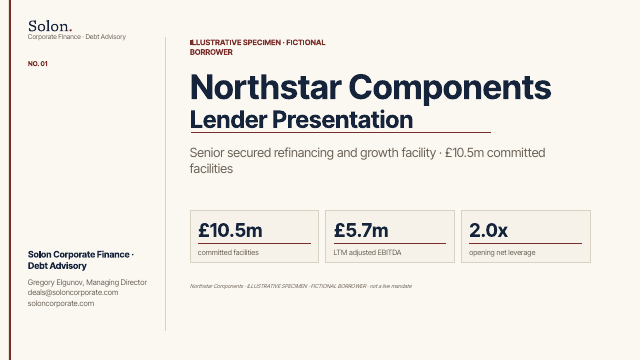
The lender presentation
Structure and negotiate.
We negotiate the terms across the capital structure, the structure of the facility, the covenants, the security and the guarantees, to the optimal shape and the best available price.
Competitive tension, properly run, is what optimises a financing. It tightens structure, widens covenant headroom and sharpens price.
- Solon produces
- Negotiated terms on structure, covenants, security and price, held to competitive tension.
- The client provides
- Decisions on the commercial trade-offs, and any diligence inputs the lenders call for.
The terms a single lender offers when it believes it is the only option are rarely the terms a well-run process produces.
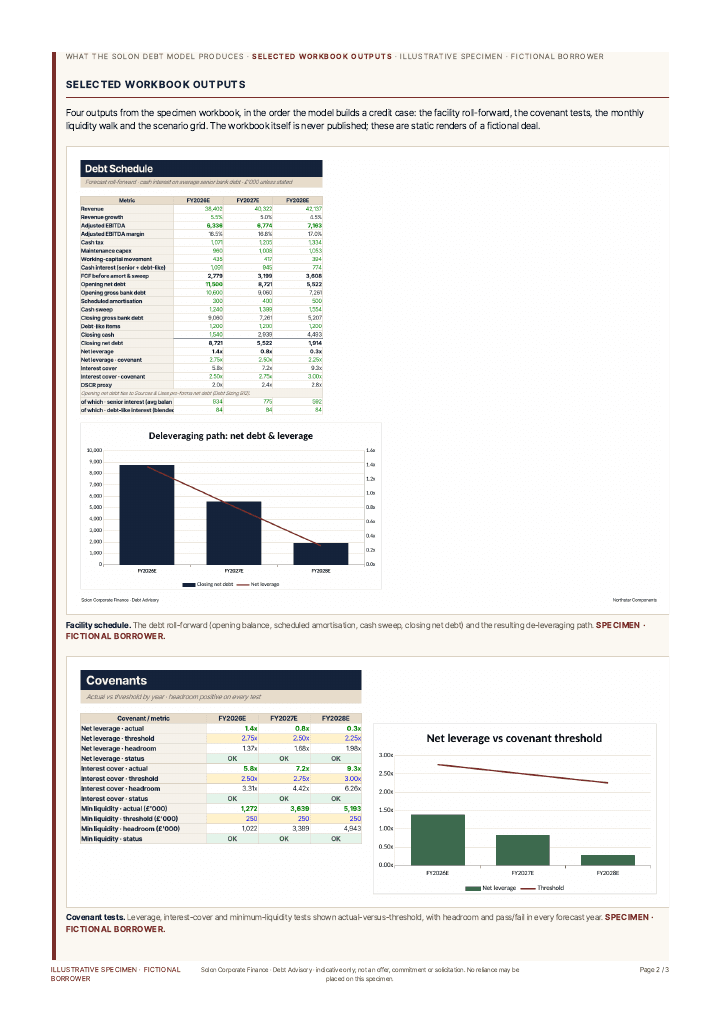
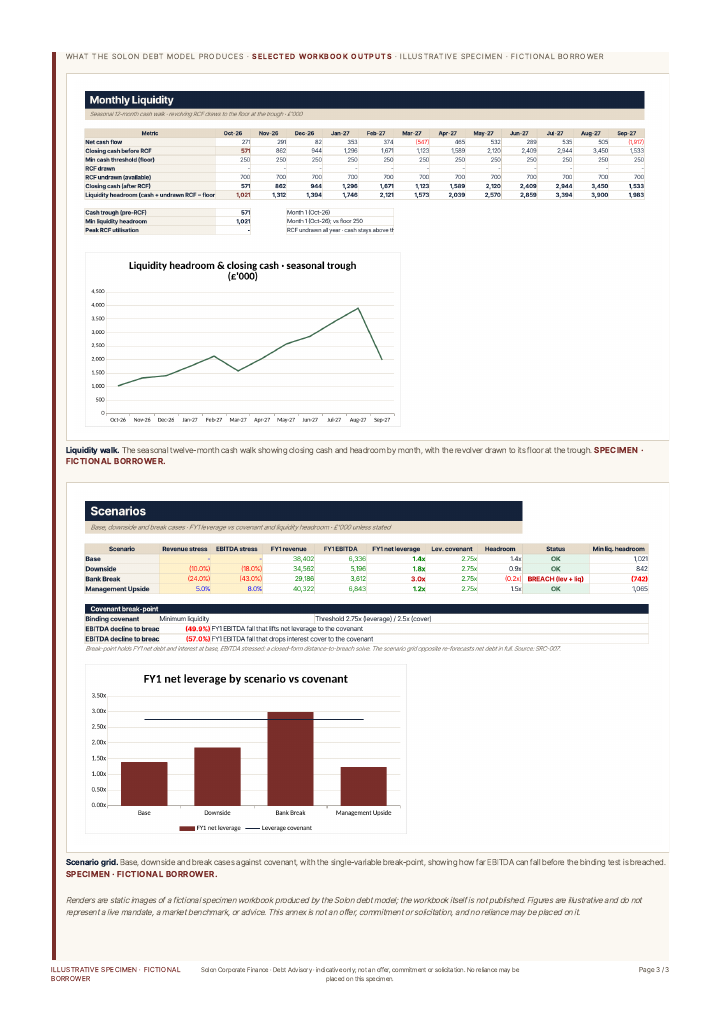
The debt model
Through to close.
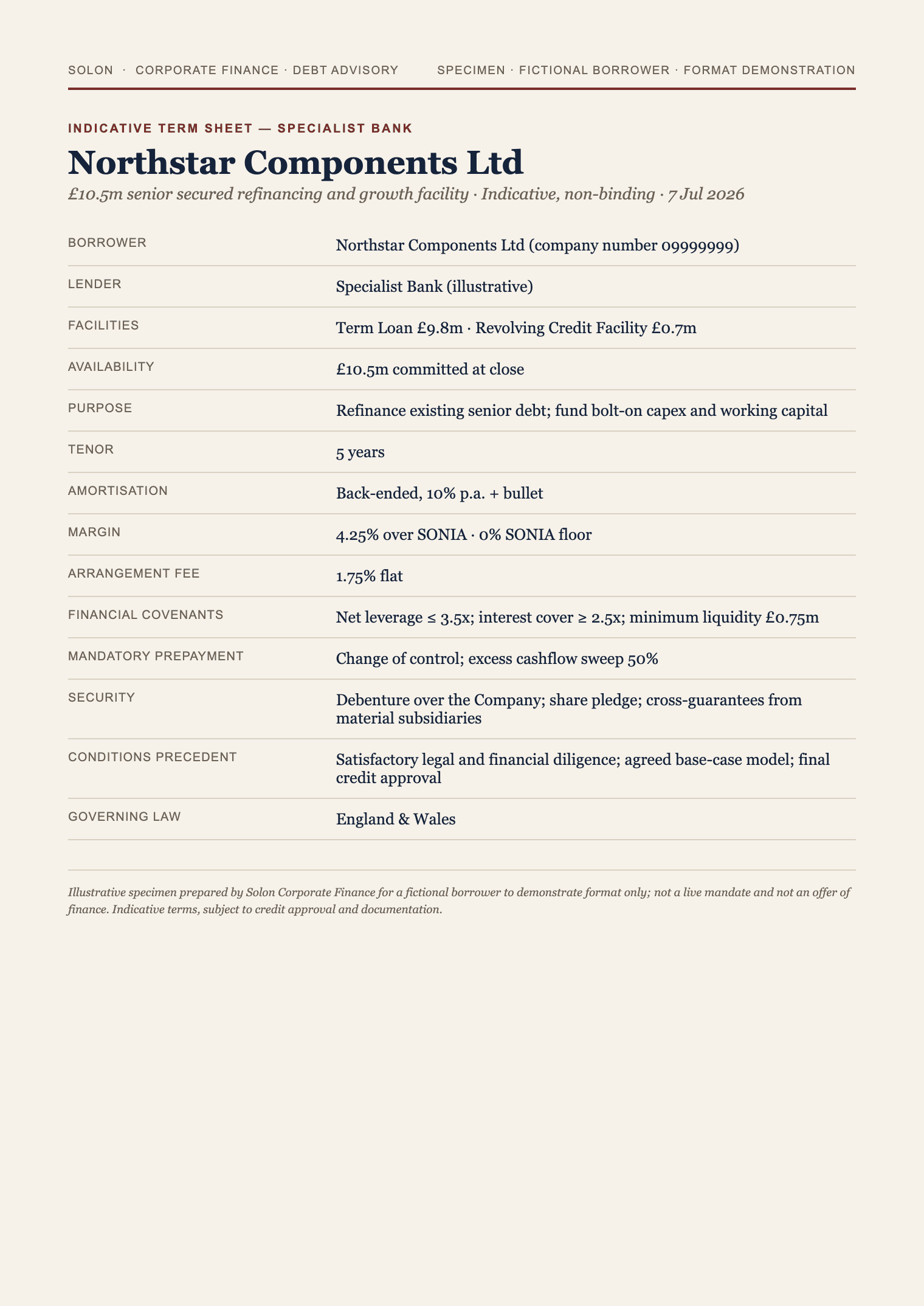
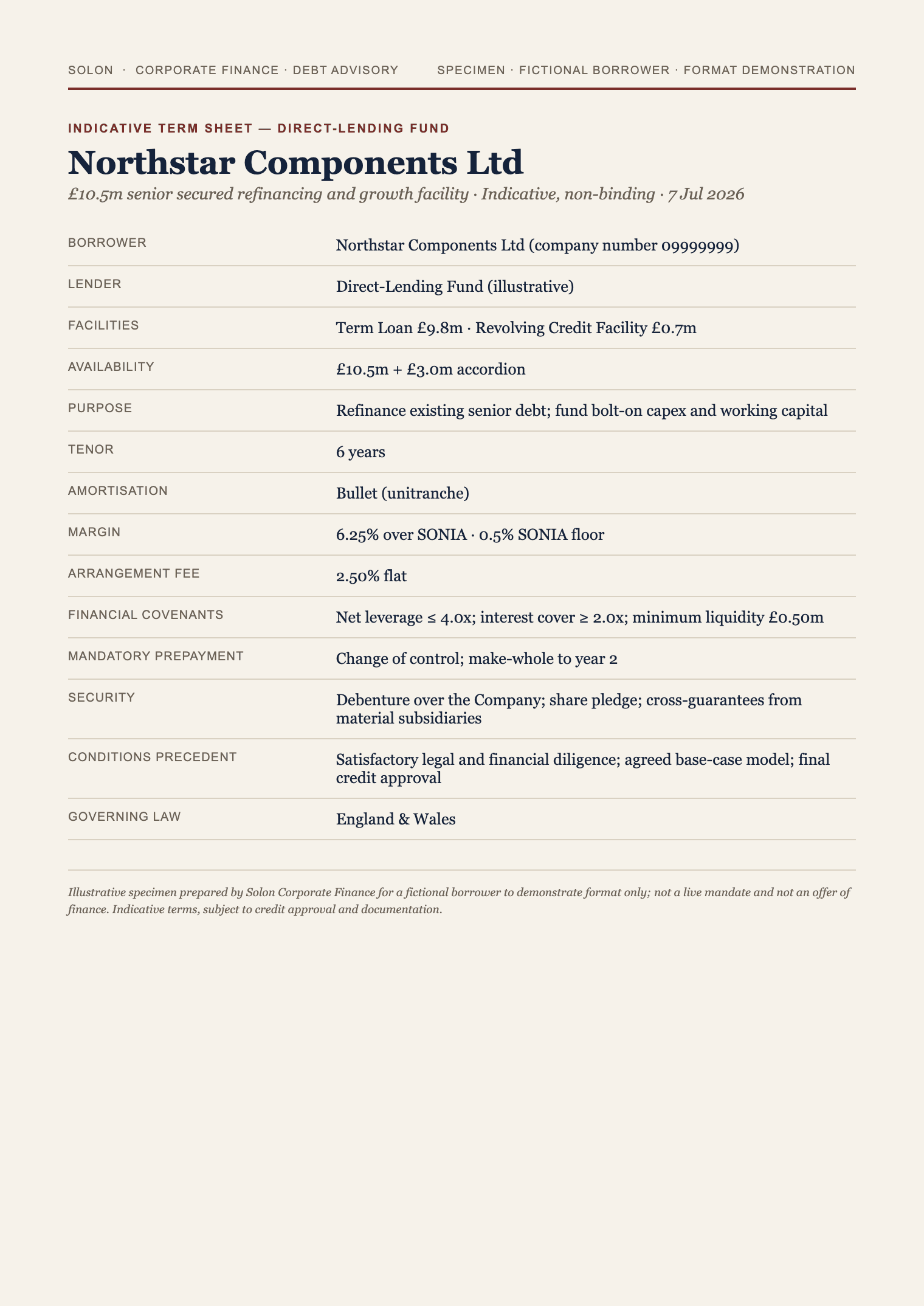
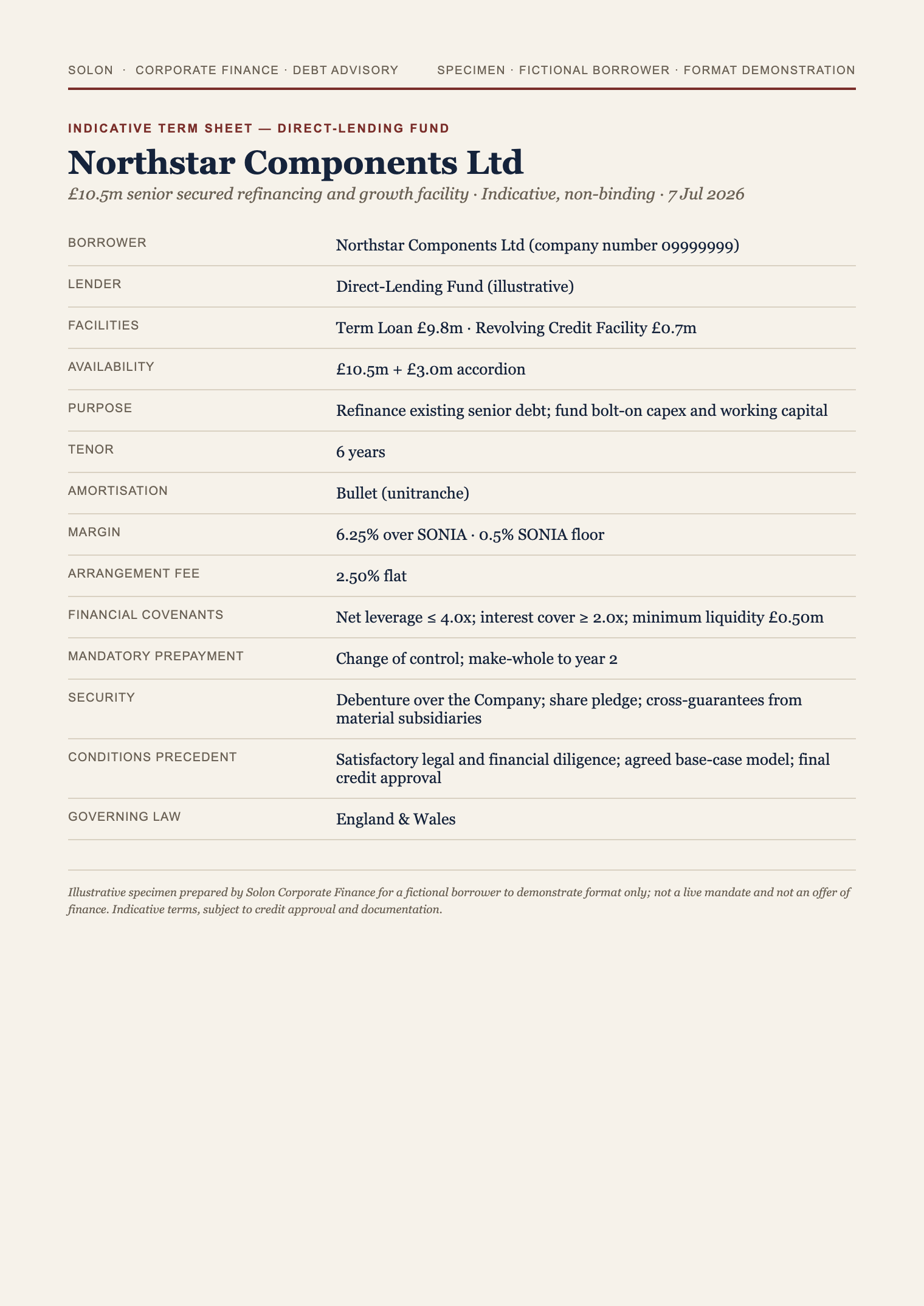
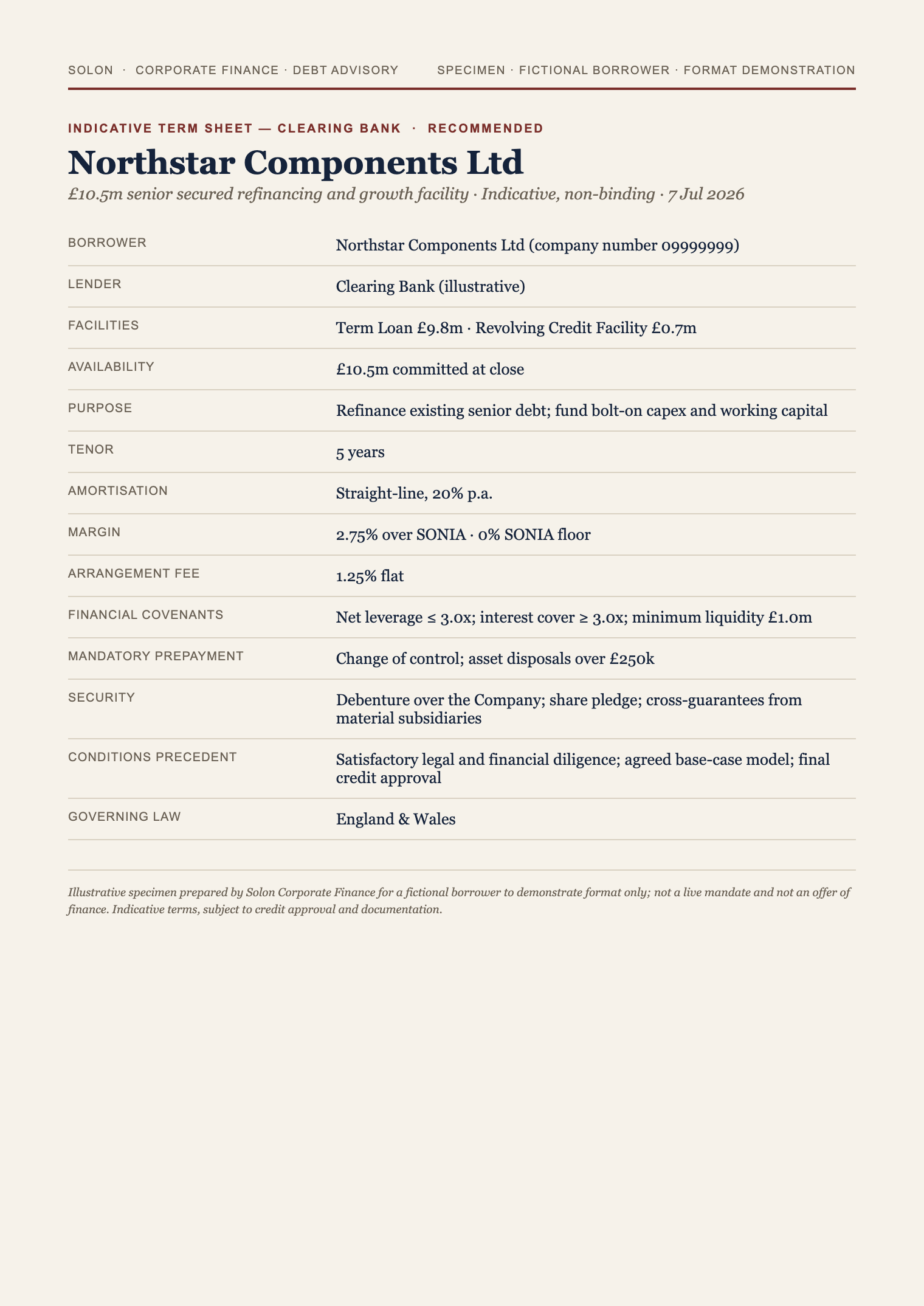
We take the financing through credit documentation to completion, with every term sheet set side by side and a clear recommendation on each: what is market, what is not, and where each lender will move. The client decides.
- Solon produces
- The term sheets set side by side, a recommendation on each, and the deal through to drawdown.
- The client provides
- The final decision, and the time to close out diligence and legal documentation.
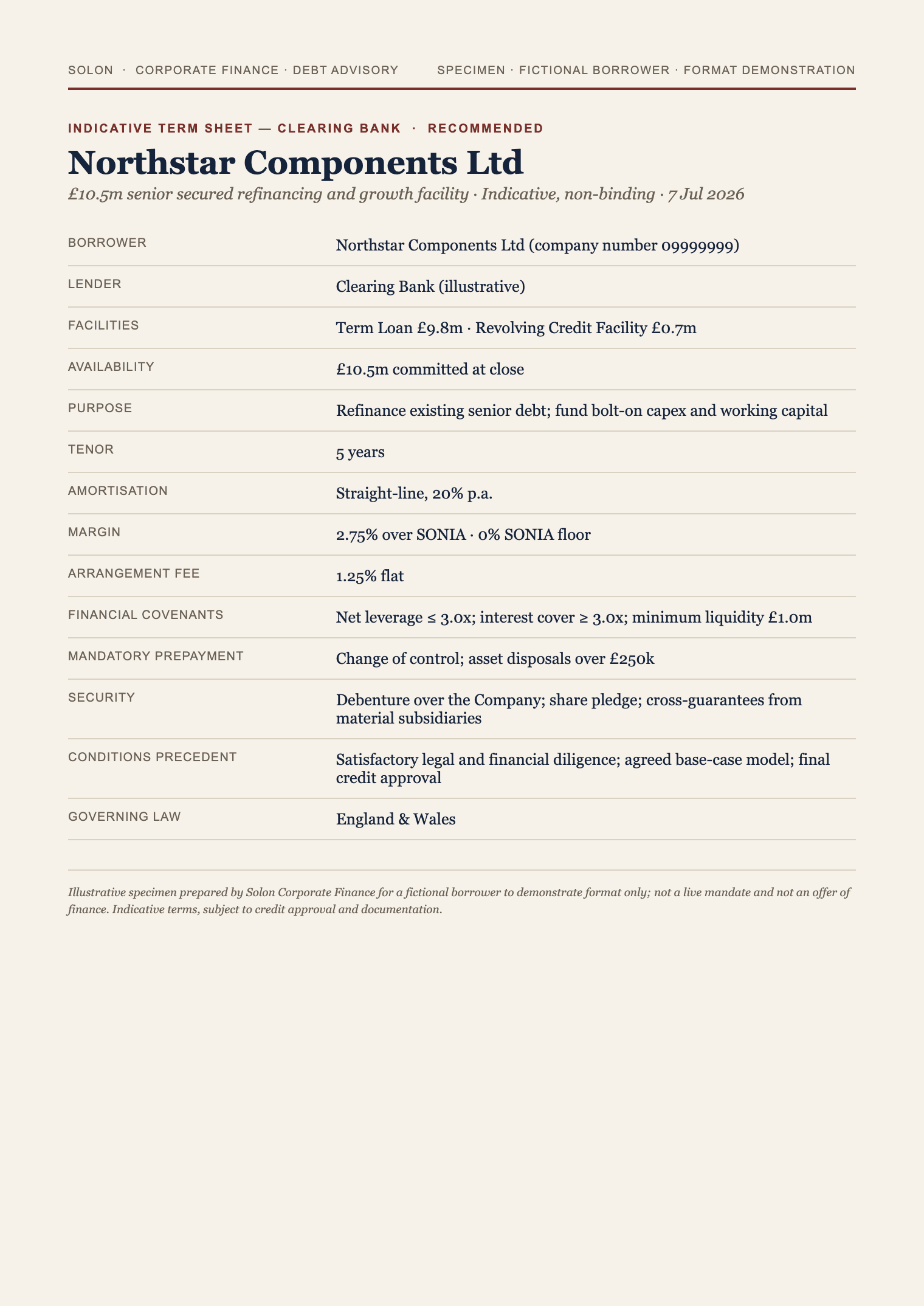
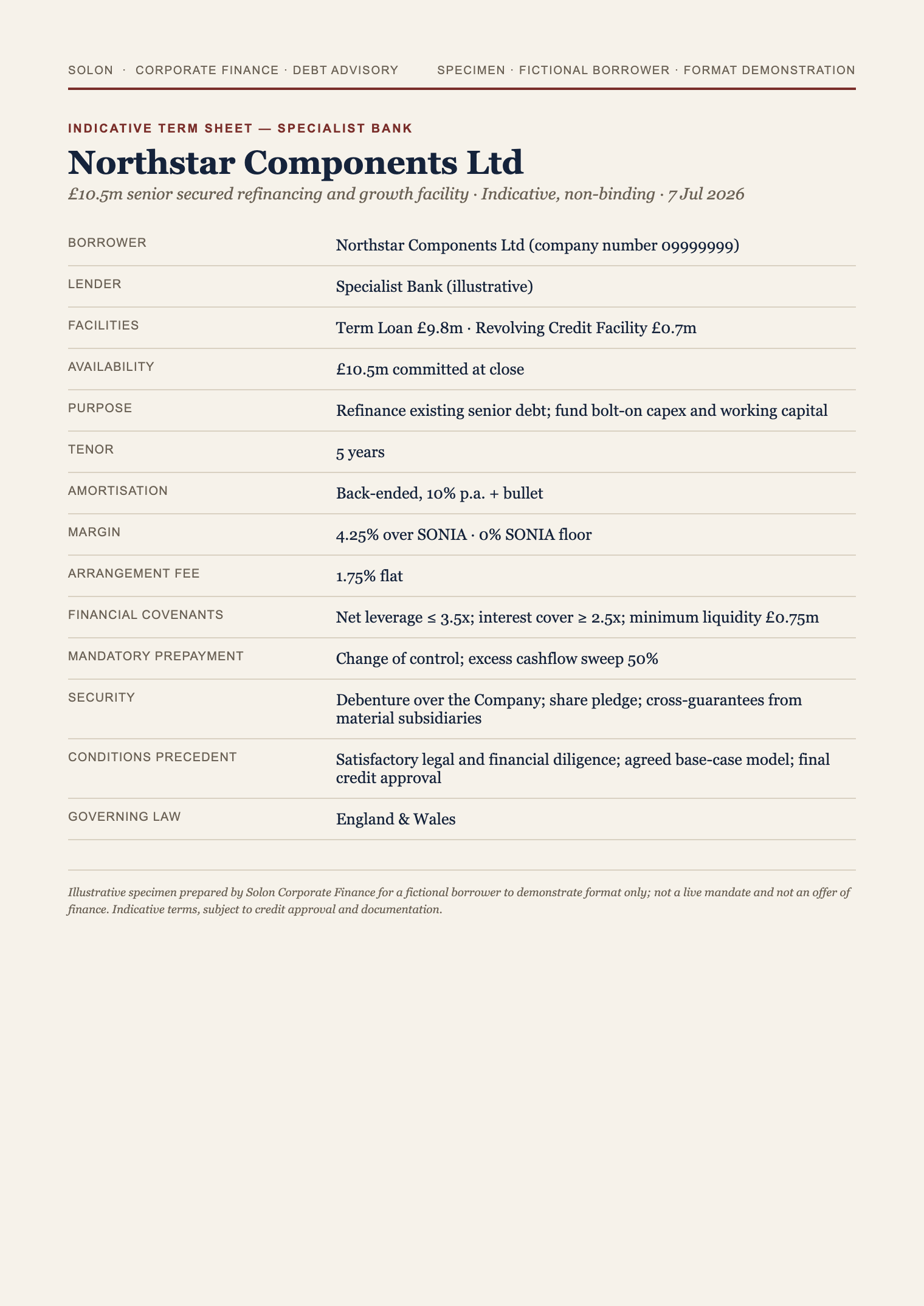
Term sheets, side by side
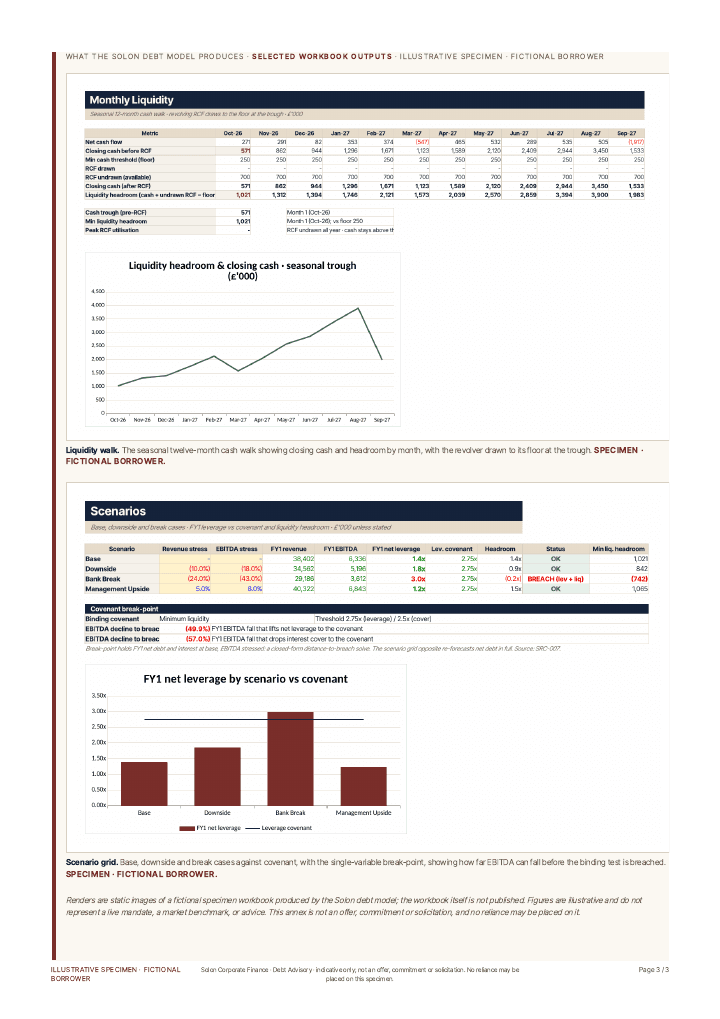
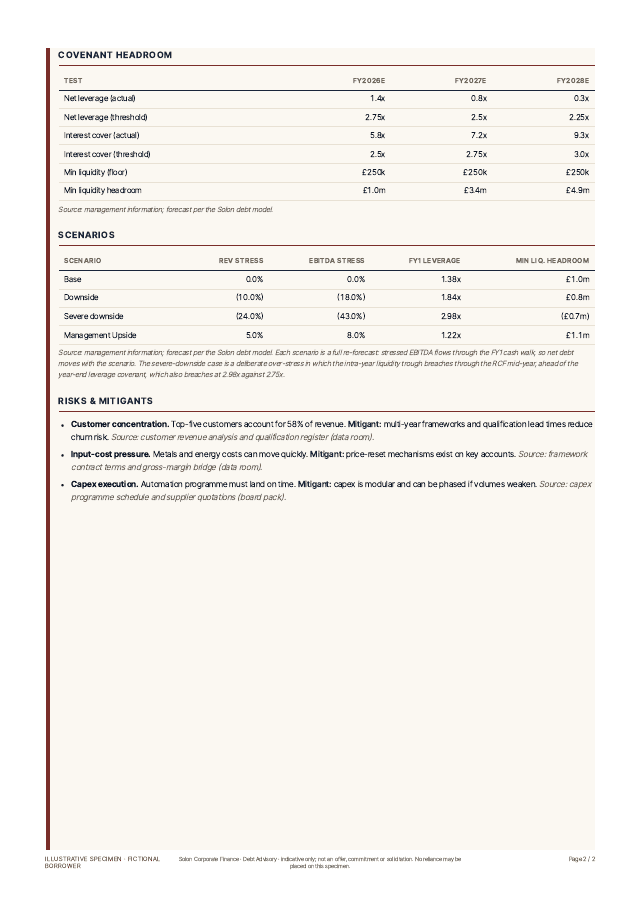
The deal, assembled
Everything gathers into one data room.
Every stage produces real work product. By the close it has come together as a single, lender-ready data room — with one clear recommendation on the best terms.
A wave of facilities falls due in 2026–27.
Covid-scheme lending, Bounce Back and CBILS written on six-year terms in 2020–21, reaches its final maturities in 2026 and 2027, the cohort that sits squarely in the lower-mid-market. A leveraged and mid-market wall runs alongside it and extends into 2028; in its 2025 Financial Stability Report the Bank of England estimated that around 40% of UK leveraged loans fall due within two to three years. For a borrower, the maturity itself is the point of maximum leverage, so it is the moment to run a process rather than roll the facility over with the incumbent.
A refinancing wall concentrated in 2026–27, as six-year facilities come due.
| Year | Covid-scheme final maturities | Leveraged & mid-market (illustrative) | Total |
|---|---|---|---|
| 2025 | £8bn | £10bn | £18bn |
| 2026 | £30bn | £15bn | £45bn |
| 2027 | £28bn | £18bn | £46bn |
| 2028 | £10bn | £22bn | £32bn |
| 2029 | £4bn | £18bn | £22bn |
- Covid-scheme final maturities
- Leveraged & mid-market (illustrative)
Covid-scheme totals and six-year terms are reported; the allocation into maturity years, and the leveraged / mid-market overlay, are illustrative. The Bank of England estimates ~40% of UK leveraged loans mature within two to three years. The concentration in 2026–28 is not in doubt; the precise annual £ split is.
We are paid by the client we act for.
We are paid by the client we act for: a success fee on completion, with any retainer credited against it. The engagement is discussed plainly at the outset and confirmed before any work begins.
An institutional process, from a focused team.
Our Managing Directors use AI-assisted research and workflow tools to support analysis and transaction preparation. We map and rank every credible lender for a given credit in days, across banks, specialist lenders and private-credit funds, against a live read of appetite built from the other side of the table.
The saving goes to senior time on the parts of a financing that decide the outcome: the structuring, the negotiation and the relationships that move a term sheet. A focused firm can now bring bank-tier process to the lower-mid-market, a tier the established houses have looked past. The work a lender sees still carries the lead Managing Director’s sign-off on every line.
Start with a confidential conversation.
A mandate starts long before step 01. If a financing is on your horizon, whether a raise, a refinancing, or terms you are weighing, the first conversation is confidential and without obligation, and it is where we tell you plainly whether a process is worth running at all.